Voter Registration Coordinators in High Schools
Texas has required a named voter registrar in every high school since the ’80s — and still can’t get schools to comply. Stuyvesant’s chapter leaders argue that every state should implement some form of the role regardless.
By James Lu, Staff Writer · September 5, 2026 · 7 min read
Almost no one came to our table.
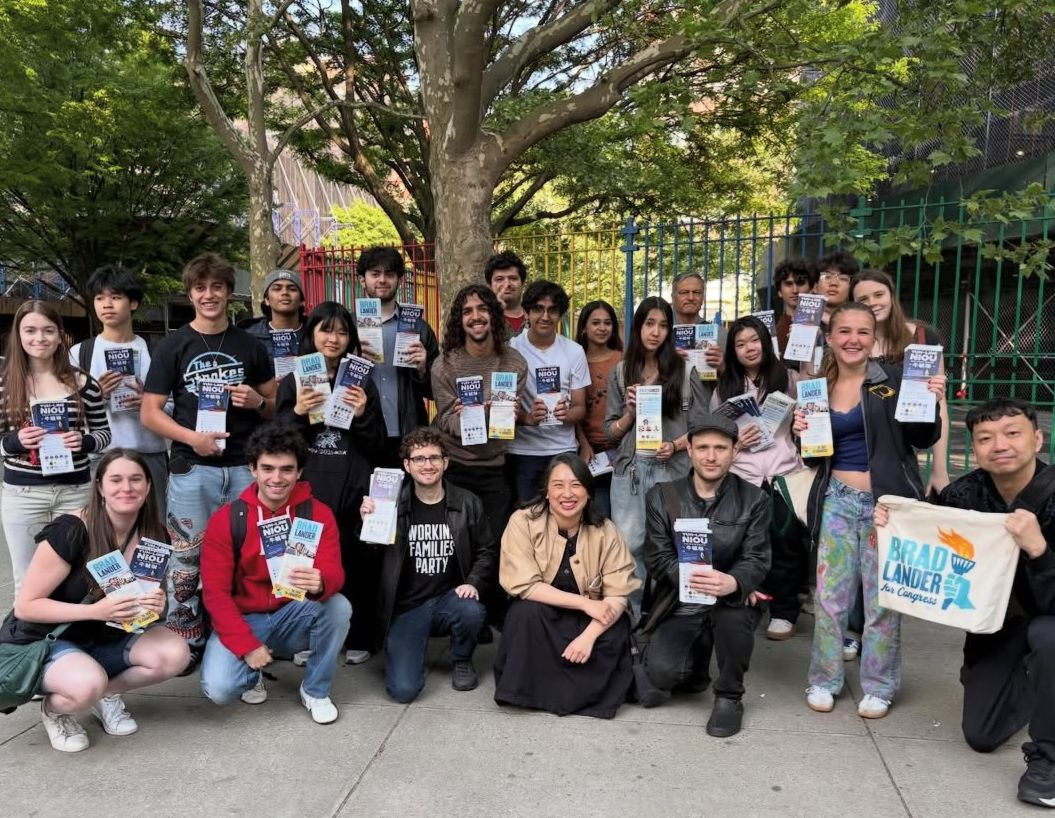
I had spent the better part of the day standing behind a foldable table at the main entrance of the school. We were set up beside a poster saying “PREREGISTER TO VOTE”, as we tried to get anyone we knew to fill out a form before the next period’s bell rang. I was one of the chapter leaders, meaning I was one of those responsible for making this whole thing even begin in the first place. We had pens. We had the eligibility rules and process written down so we wouldn’t have to repeat them every time from scratch. We stocked up on 5 Gum spearmint flavor, a box of Welch’s gummies, and even had a friend run down to the deli during his lunch period to grab some chocolate. However, for long stretches of most periods, what we really had was nobody.
Though the responses we did get were mixed. Less than a handful of students signed up on the spot. More walked past, barely looking over. A couple even stopped just long enough to let us know politely that they didn’t see the point of registering for something local or not as pristine if they couldn’t vote for president yet anyway. When midday rolled around, we had basically given up on waiting for people to come to us and decided to leave the table as it was, making sure though, that the instructions were clear enough if anyone wanted to stop by while we were gone, and started walking through the halls instead. We tried getting the attention of students at their lockers, in the bathroom line, or anywhere else for just 30 seconds of their time, and ultimately it worked better. At the same time, it was exhausting, as a lot of it came down to just being loud and persistent in a hallway. None of this should’ve depended on us being loud enough. Technically, New York has required schools to have some version of this program beginning in 2019.
In many arguments about the lowering of the preregistration age or making the requirements for who gets a ballot broader, this gets left out a lot. These changes are all made under the assumption that once a state says 16- or 17-year-olds can preregister, the hard part is over, and it isn’t. Lots of stuff comes with registering to vote for the first time, such as picking a party you may not have thought about before or trying to figure out which address counts as yours once you leave college. According to researchers who study why even motivated college students pass on forms they in actuality have “easy” access to, these are the actual barriers.
According to youth civic engagement researchers at Tufts University’s CIRCLE program, fifteen states and Washington, D.C. now let 16-year-olds preregister. Most importantly, though, a right to preregister doesn’t mean much if no one at your school is going to take responsibility to make sure you know it exists.
The country’s oldest answer to this problem originated in Texas.
It’s worth taking a look at since it does more than most states do but still isn’t enough. Since the 1980s, the law has designated every Texas high school principal (or it could be a staff member the principal appoints) as the school’s official “High School Deputy Registrar.” This title has the responsibility of distributing registration forms to eligible students at least twice a year minimum. The deputy registrar must also check the forms for completeness and deliver them to the county. This system assigns a job description titled to a person at every public and private high school across the whole state.
And still, 40 years later, compliance is still inconsistent enough that the Texas Civil Rights Project has had to step in and run administrator training and how-to guides to ensure schools follow an already established law. Additionally, an Austin American-Statesman opinion piece was straightforward and ran under the headline “Texas law says high schools must register voters. Many don’t.” It’s important to acknowledge, though, that a law that names a person responsible is a great improvement over a law that doesn’t, but it fails in some instances since it’s not self-executing. New York had its own version of this law, but it only makes the aforementioned divide more prominent. Since 2019, and in a strengthened form in 2023, NY state law has made it so that every school district, charter school, and private high school is required to adopt “policies and procedures” that promote student registration and preregistration. Unlike Texas, no one is named to run it, so it just sits as a policy in a binder. This issue is exactly what the 3 of us tried to fix on our own for a day with some pens and a table in a school the size of Stuyvesant.
We can look at other states like California that may have a more convincing approach than Texas.
Its AB 2724 lets high schools formally appoint students as “voter outreach coordinators.” This is overseen by the school administration, which allows registration drives and other activities to be run on campus, and to top it off, a separate requirement is also in place where every student is taught how to preregister before the end of 11th grade. Something similar is also seen in Massachusetts, where a student can apply for the coordinator role or get nominated by classmates under the “high school voter challenge program.” What our chapter was trying to do informally, both had an already formal and established version.
A real person doing the outreach backed by the school is an effective combination, and research supports this. CIRCLE’s surveys find that students who were not only taught how to register but also encouraged to do so throughout high school were far more likely to know where to find registration information later, with 76% compared with 49% of students who had received neither. A different finding, though a little less encouraging, found no actual bump in youth turnout from civics requirements alone in a 2024 study of state-mandated civics tests, so knowing about government abstractly doesn’t meaningfully result in knowing how to register, and someone still has to walk you through the form process. Pushback against these laws shouldn’t be waved off, though. This spring, when Illinois lawmakers debated a similar bill, Republican Representative Bill Hauter mentioned how it amounts to an unfunded mandate on schools already stretched thin. Separately, Representative Jason Bunting worried that registration drives could very well dip into partisan territory. The funding issue is already solved in Texas, as they attached the responsibility to a job that’s already in place. Illinois has its own bill where it lets outside nonprofits help schools tackle the load. Additionally, in every version of this law I found (NY included), this type of work is defined strictly as nonpartisan, such as handing out forms, deadline explanations, or walking someone through an online version. With this, there’s very little room in that description for anyone’s opinions to seep in.
With everything in mind, I don’t want to overstate what would actually be fixed with a coordinator. Access problem and interest problem are two different things, exemplified by Newark allowing 16-year-olds to vote, and that handing a teen a table, form, or even ballot doesn’t just manifest interest in a school board race. Whether there was a coordinator or not, some walking past our table would never stop. But that just adds to the side of taking the interest problem seriously too. This could be through better instruction in civics or garnering more attention and curiosity in school board elections or anything else it takes.
If and when Stuy runs another push for registration this school year, I’m hoping it comes with a title attached like the staff coordinators in Texas, or the trained and backed student role that Massachusetts and California have.
VOTE is currently trying to introduce a bill with this general idea into NY. If you are interested in helping VOTE with advocacy or know legislators interested in introducing a bill, contact voteofteens@gmail.com.
Bibliography
- “High School Deputy Voter Registrars.” Texas Secretary of State.
- “Texas High School Deputy Registrar Guide.” Texas Secretary of State.
- “Texas Law Says High Schools Must Register Voters. Many Don’t.” Austin American-Statesman, 3 Feb. 2026.
- “The Impact of Voting Laws on Youth Turnout and Registration.” CIRCLE, Tufts University.
- “Youth Who Learned about Voting in High School More Likely to Become Informed and Engaged Voters.” CIRCLE, Tufts University, 31 Aug. 2020.
- Jung, Jilli, and Maithreyi Gopalan. “The Stubborn Unresponsiveness of Youth Voter Turnout to Civic Education: Quasi-Experimental Evidence From State-Mandated Civics Tests.” Educational Evaluation and Policy Analysis, 2024.
- “Motivating Student Voter Registration.” Humanities and Social Sciences Communications, vol. 11, 20 Jan. 2024.
- “Bill Text - AB-2724 High School Pupils: Voter Registration.” California Legislative Information.
- “Section 26A: High School Voter Challenge Program.” General Laws of Massachusetts.
- “Illinois House Republicans Split on Bill Allowing Eligible High Schoolers to Register to Vote.” WSIU, 17 Apr. 2026.
- “New York State High School Voter Registration Guidance.” New York City Bar Association.
- “Requirement to Adopt Policy Promoting Student Voter Registration.” New York State Education Department, 8 May 2025.
- “5-507 - Voter Pre-Registration and Education on Voter Pre-Registration.” New York Election Law, Justia.