Racial Gerrymandering
Did systemic racism in voting really disappear after the Voting Rights Act? Modern racial gerrymandering says no.
By Jed Anglo, Staff Writer · August 29, 2026 · 3 min read
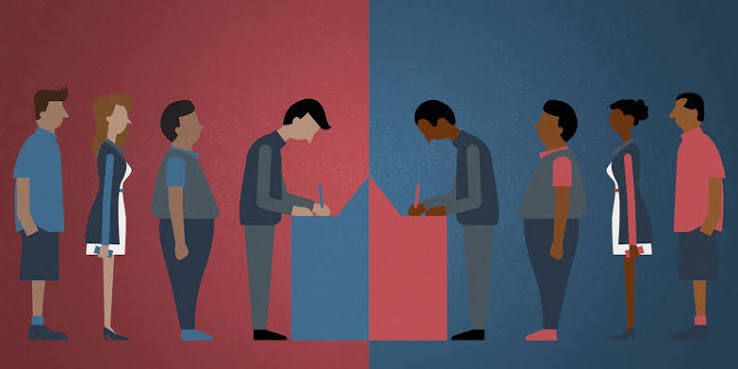
“No voting qualification or prerequisite to voting, or standard, practice, or procedure shall be imposed or applied by any State or political subdivision to deny or abridge the right of any citizen of the United States to vote on account of race or color” — Voting Rights Act (1965)
Technically, this statement is law. In layman's terms, all American citizens should have an equal opportunity and ability to vote. But does that mean that all votes are created equally? Although many optimists say that the Voting Rights Act of 1965 largely solved our country’s problematic history of restricting minority voices in the voting process, the spirit of racial discrimination still heavily exists in our institutions. Many have pointed to one of the main ways in which racialized voting practices continue to give an inaccurate and prejudged representation of the population in national government— that being racial gerrymandering.
According to bipartisanpolicy.org, racial gerrymandering is the practice of drawing electoral district lines to lessen the voting power of particular racial minority groups. District lines initially may not seem like a large impact on voting; after all, a vote in one district is equal to a vote in another district, right? In American voting practices, that’s not necessarily the case.
In addition, there are two types of racial gerrymandering, called packing and cracking. In both methods, census data that tracks information such as race and party affiliation from every US district is used to attempt to draw districts that can be safely won by whatever party is in charge of drawing district lines. More often than not, these district lines are suspiciously correlated to minority racial groups either being all lumped together into a small number of districts to where majority racial groups hold the majority of districts (packing) or these minorities spread too thin across districts to where they are a minority in every district, making it harder to form a majority (cracking).
Technically, these practices are highly illegal, yet they are seeing an upward trend in usage. Even though the Voting Rights Act technically marked this technique as deviant and illegal, the modern era has found workarounds. The Harvard Kennedy School analyzes these recent developments. Specifically, in the summer of last year, President Trump demanded that the Republican-controlled Texas state legislature (aka the people in charge of district lines) engage in gerrymandering to all but guarantee 5 more Congress seats for Republicans in the midterms. This was seen by many, including the NAACP, as done through implicit racial means, as it made it so that white voters control over 73% of Texas’ congressional seats even though they only make up 40% of the population. This has started an arms race that continues to this day, with partisan strongholds such as Florida and California also gerrymandering their maps to counteract each other’s party, leading to one of the biggest eras of gerrymandering in modern history.
Is this civil war using gerrymandering technically illegal? The quote from the Voting Rights Act at the beginning of the article makes it clear that Texas’ gerrymandering is flagrantly unconstitutional, so why hasn’t the Supreme Court stepped in to enforce the act? Well, the problem of racial gerrymandering is so systemic that even with these laws in place, even the Supreme Court itself refuses to enforce them. The Harvard Kennedy School uses previous cases such as Callais v. Louisiana to claim that for the Supreme Court to enforce the Voting Rights Act, intentional and blatant racial discrimination rather than the effect of racial discrimination must be proved. This means that for state legislatures seeking to commit racial gerrymandering, the only requirement to get around the law is to not explicitly state that the gerrymander was for racial reasons, even if the results of the gerrymander are obviously in a racial context. This makes these gerrymanders technically legal until this precedent is changed.
So what does that mean for youth voting?
For youth voters in gerrymandered areas, these first-time minority voters will perceive their vote as meaningless, where the district they live in subconsciously makes clear that their vote will not matter in election processes, leading to a decline in democracy. Thus, it’s time for a change in our racialized system and to advocate for a better change, where all votes are treated as equal and where the Voting Rights Act truly means something other than an unsupported declaration.
Bibliography
- Explainer: What’s happening with gerrymandering in the United States—and who will “win” the redistricting battle? (2026, May 4). Harvard.Edu.
- NAACP Celebrates Major Court Victory Blocking Texas’ Racially Gerrymandered Congressional Map. (2025, November 18). Naacp.
- National Archives. (2022, February 8). Voting Rights Act (1965). National Archives.
- Redistricting and Gerrymandering: What to Know | Bipartisan Policy Center. (2025). Bipartisanpolicy.Org.